
When people think about tea, they think about origin.
Assam. Darjeeling. Nilgiri.
It creates a sense of authenticity — as if origin alone defines quality.
But here’s what most people don’t see:
The journey of tea doesn’t end at the garden.
That’s where quality starts getting tested — and often lost.
The Real Journey of Tea (Beyond the Garden)
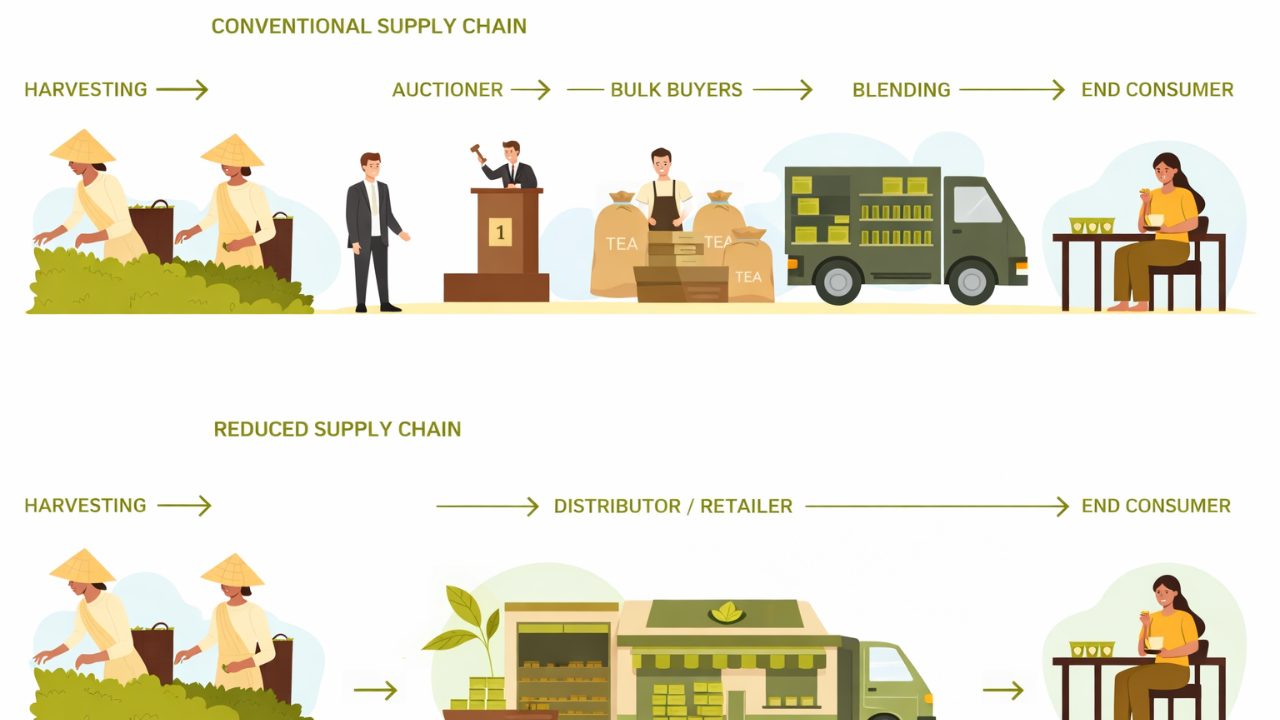
Tea rarely travels directly from the estate to your cup.
Instead, it moves through a chain:
Estate → Auction or Bulk Buyers → Blenders → Distributors → Retail
At every stage, decisions are made.
And those decisions are not always driven by quality —
they are often driven by:
-
Scale
-
Availability
-
Cost efficiency
With every step, the tea moves further away from its original character.
Where Most Tea Loses Its Quality
1. Bulk Sourcing Over Selective Sourcing
To meet demand, tea is often purchased in large volumes.
This leads to:
-
Mixing of multiple batches
-
Loss of distinct flavor profiles
-
Reduction in overall quality
What starts as a well-defined tea becomes increasingly generic.
2. Over-Blending to Maintain Uniformity
Blending is a tool.
But when overused, it becomes a compromise.
To maintain a “standard taste,” multiple inconsistent batches are combined.
The result:
-
Flattened flavor
-
Reduced complexity
-
Artificial consistency instead of natural consistency
3. Storage and Handling Gaps
Tea is highly sensitive to:
-
Moisture
-
Air exposure
-
Time
Long supply chains mean:
-
Extended storage periods
-
Multiple handling points
-
Limited control over conditions
All of which quietly degrade quality.
4. Time — The Silent Factor
The longer tea sits in the supply chain, the more it loses:
-
Aroma
-
Freshness
-
Character
By the time it reaches you,
it’s often no longer what it was meant to be.
The gap between garden and cup is where most of the quality disappears.
👉 Explore the Asmi Tea Collection
Why This System Still Exists
Because it works at scale.
It enables:
-
Large distribution networks
-
Predictable inventory
-
Faster market reach
But it also creates a trade-off:
👉 Efficiency over integrity
Most brands accept this trade-off.
We don’t.
Our Approach at Asmi Tea: Reducing the Gap
At Asmi Tea, we started with a clear question:
What if we could reduce the distance between the source and the customer — not just physically, but operationally?
So we built our approach around one principle:
👉 Create a more direct and controlled sourcing channel
This means:
-
Working closely with trusted suppliers
-
Bringing tea closer to the source
-
Reducing unnecessary intermediaries wherever possible
What This Changes for You
By reducing the gap, we’re able to:
-
Preserve the original character of the tea
-
Maintain freshness for longer
-
Deliver a more reliable and consistent cup
Not by over-processing or over-blending —
but by interfering less, and controlling better.
Because Good Tea Is Not Created — It’s Preserved
Great tea already exists at the source.
The real challenge is:
how much of it survives the journey.
The shorter and more controlled that journey is,
the closer your cup gets to what it was meant to be.
A Better Cup Begins Long Before Brewing
By the time you brew tea, most of the outcome is already decided.
You can’t fix:
-
Poor sourcing
-
Long storage cycles
-
Excessive blending
You can only choose tea that minimizes these compromises.
Choose Tea That Stays Closer to Its Source
Choose tea that stays closer to its source —
and closer to its true taste.
👉 Shop Asmi Tea